
Celebrating U of T’s accessibility advocates

December 3 is International Day for Persons with Disabilities and Student Life is celebrating U of T community members who have increased accessibility, visibility and possibility on campus and beyond.
Ian Parker

Ian Parker played a groundbreaking role in the development of accessibility at U of T. Having experienced a life-altering spinal cord injury leading to a level of paralysis in his arms and legs, Parker used a manual wheelchair for mobility.
When he enrolled in U of T’s Faculty of Music in the 1970s, he encountered staggering challenges, as accessibility at the University was in its infancy.
His response was to take action. Parker lobbied U of T to build a ramp that eased his entry into the Faculty of Music building, and co-created a group of students and faculty called Access U of T. The group challenged University administration to expand accessible services and infrastructure, enhancing accessibility for all students.
Access U of T became a key component of the development of accessibility at the University of Toronto and contributed to Ian Parker’s enduring legacy in the community.
Learn more about Ian Parker:
‘Empathy and strength’: Ian Parker was an early accessibility advocate on campus – and beyond
Beau Hayward
Beau Hayward is a powerful example of the impact one student can have on campus. After sustaining a spinal cord injury in a swimming accident, Hayward became paralyzed from the neck down and, after intense rehabilitation, began using a wheelchair as a mobility device.
His dream was to study history at U of T and while his future looked different than he imagined as a child, he decided to pursue his passion and apply to U of T as a mature student.
Throughout his time in undergrad, Hayward advocated for himself and others by advising the University on accessible ramps and campus spaces, while developing opportunities for students with disabilities to take part in sports and physical activities.

“The fact that Beau has embraced his new lifestyle and has become so passionate to create an accessible campus for all students is pretty inspiring,” said Michelle Morgani, Hayward’s accessibility advisor. “His passion to create spaces for all students, and the dedication to accessible sports/activities is something to be admired.”
Learn more about Beau Hayward’s accomplishments:
Bocce Ball and Beyond: One U of T Student’s Mission to Cultivate More Accessible Spaces on Campus
This Toronto man nearly died in a diving accident. Now, he’s graduating from U of T.
David Onley

David Onley made history by becoming Canada’s first on-air reporter with a visible disability. The UTSC alum was a survivor of childhood polio, which left him partially paralyzed from the waist down.
Throughout his distinguished career as Lieutenant Governor of Ontario, broadcaster, best-selling author, accessibility consultant and much more, Onley continued to advocate for disability rights.
He served as U of T’s accessibility ambassador and was a senior lecturer in the Department of Political Science at UTSC, creating and instructing the courses “Politics of Disability” and “Sources of Power: The Crown, Parliament and the People.”
Onley’s advocacy for accessibility had an undeniable impact on the University of Toronto, the Province of Ontario, Canada and the world. His legacy lives on and inspires fellow accessibility champions at U of T and across the globe.
Mae Brown
In 1972, Mae Brown accepted her graduation hood at Convocation Hall – making her Canada’s first university graduate without hearing or sight.
Living with health conditions that disrupted her central nervous system and led to the loss of both her vision and hearing, Brown was determined not to give up on her dreams of higher education. She had a dedicated tutor named Joan Mactavish who adapted ways to communicate with Brown and assisted the determined student throughout her academic journey.
After graduating, Brown developed services for the Canadian National Institute for the Blind (CNIB) until her death one year later at the age of 38. To carry on Brown’s legacy, Mactavish contributed to a study with the CNIB and helped to implement its key recommendations, including a formal training program for “intervenors” for the deaf-blind.
Learn more about Mae Brown and Joan Mactavish:

Alex Lu
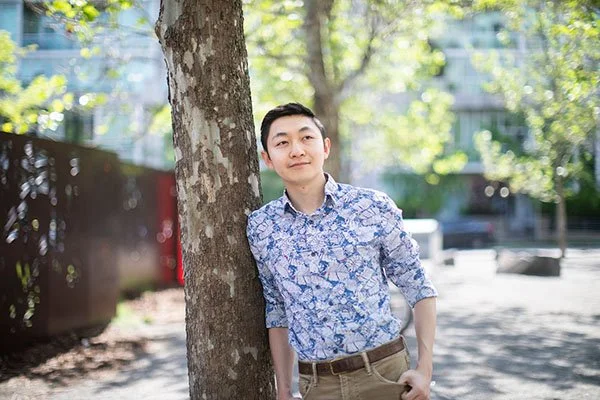
Computer science alumnus Alex Lu is building a career at the forefront of the deep learning revolution, where curiosity and courage shape his path. Now a senior researcher with Microsoft’s New England Research and Development team, he focuses on how artificial intelligence can accelerate discovery in the biological sciences. Since earning both his master’s and PhD in computer science at the University of Toronto, Lu has embraced a methods-driven approach that lets him move across disciplines and tackle complex problems in unfamiliar territory.
His doctoral supervisor, Professor Alan Moses, highlights Lu’s rare willingness to adapt methods to new areas and sees him as part of a generation driving extraordinary change.
“It’s hard to overstate the excitement and the possibilities AI and deep learning are bringing to our research,” he says. “Alex is really at the forefront of that revolution.”
This openness has led Lu beyond computational biology into human-centered AI. In one project, he helped create ASL STEM Wiki, a dataset of science content in American Sign Language to expand access for Deaf and hard-of-hearing learners. In another paper, he co-authored a critical review of AI research on sign language, identifying systemic biases and calling for greater leadership from Deaf researchers.
As an ASL-using student, Lu worked closely with interpreters to develop specialized terminology and he championed a model of service provision that ensured interpreter availability, enabling his engagement in collaborations across departments and internationally.
Beyond his research, Lu maintained his connection to the University of Toronto by serving for several years on the Faculty of Arts & Science Dean’s Advisory Council, helping to advance its strategic priorities.
Learn more about Alex Lu:
CS alum Alex Lu is discovering new ways to apply deep learning in biology
Updated on May 21, 2026
Posted on November 25, 2025
By Sarah Ryeland-Etienne